What MediumsArt Materials Did Pablo Picasso Use What Materials Did Pablo Picasso Use
Introduction
Created as an anti-war protest piece in response to the 1937 aeriform bombing of a small town in northern Spain, Guernica quickly became one of Pablo Picasso's most-recognized Cubist paintings—and for very good reason. Its monochromatic color palette, intense contrast, and large, trigger-happy images are visceral, compelling, and unforgettable fifty-fifty today. . . for those who saw it in 1937, with international tensions running loftier and Globe War II looming on the horizon, Guernica struck home similar a bolt of lightning.
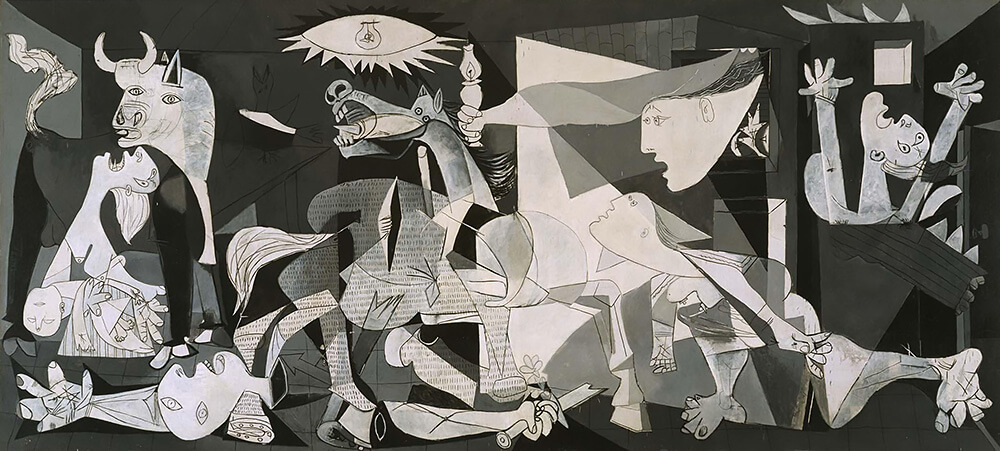
At the time, Picasso was in his mid-50'southward and living in France rather than Spain, the state of his nascency. Equally his fame grew, Picasso explored a multifariousness of artistic styles, cartoon often from Cubism (which he created with Georges Braque) and the Surrealist movement epitomized by Salvador Dali and his famous "melting clocks" painting.
The genius of Guernica is that information technology successfully combines dreamlike (some might say nightmarish) elements of Surrealism with the multiple-perspectives of Cubism. Information technology was a shocking painting, both for its mod, Cubist style and for its haunting subject matter. After existence displayed at the 1937 World'due south Off-white in Paris, Guernica went on a two-year "world tour" to encourage anti-fascist sentiment and raise funds for the troops of the Castilian Republic.
When World War II began in 1939, Guernica left Europe and was sent to New York's Museum of Modern Art for safekeeping. MoMA continued to brandish the massive painting in various The states cities and around the earth for well-nigh two decades—helping to turn Picasso and Cubism into household names.
It's difficult to say whether the bombing of Guernica would have gained such international attending without Picasso's painting drawing attention to it. Certainly the bombing was an atrocious act of violence—Guernica was a noncombatant boondocks, deliberately targeted by the NaziLuftwaffe on behalf of their ally, General Francisco Franco, who was leading the rebellion confronting the Spanish Democracy.
Nevertheless this type of warfare presently became commonplace—proving that, in its own way, Guernica was zero short of prophetic: a painting that perfectly encapsulates the inhumanity and horror of modern war, and stands equally a timeless warning of what mankind is capable of.
A quick overview of Cubism
To really sympathize Guernica, it'due south important to sympathise how Cubism differs from other fine art movements. While classical and neoclassical artists might to replicate the earth exactly every bit information technology appears in real life (or some perfected version of it) Cubists similar Picasso were open to depicting the world in more abstract means that offered new, impossible visions of reality.
At its cadre, Cubism is a method of painting a person, scene, or object from multiple angles. Picasso and Georges Braque developed this technique and used information technology to simplify and distill any three-dimensional subject area into a multi-faceted, "cubist" shape. Picasso was also profoundly influenced by the carved, athwart shapes of African masks, an inspiration that can be seen in many of his paintings.
These kinds of Cubist artworks—called Analytic Cubism, to differentiate it from a different, collage-way artwork known as Constructed Cubism—are typically cleaved upwardly into geometric segments, occasionally separated by athwart lines to form divisions between the diverse perspectives being shown. While less "geometric" than some of Picasso's before Cubist pieces, Guernica's flattened, shifting perspectives and simplified color palette are clear earmarks of the Cubist style.
Ultimately, Picasso—and Guernica—were both incredibly influential in shifting the art world towards modernism and what we now phone call "abstract fine art."
Assay of Guernica
Guernica'southward primary visual touch comes from its collection of maimed and dying figures, rendered in a stark black, white, and gray on a huge canvas. Nosotros already know about the event that led Picasso to create this painting (the bombing of Guernica) but he mixed in a lot of symbolism likewise, conveying deeper meaning for both himself and the Spanish people.
For our in-depth assay of Guernica, let's break the painting downwardly into three parts: color and way, symbols, andhuman figures.
Color and style
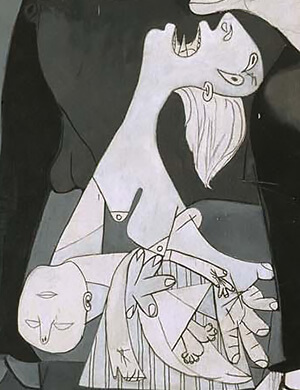 Picasso didn't desire to distract from his message by including color, so he eventually made it all stark white, blackness, and gray. Originally, he'd painted a crimson tear on the adult female's face up, just ultimately decided not to continue it. Information technology makes sense why he did that. . . with no colour, at that place'due south no relief from what you're seeing, and there'south also no unintended (or intended) focal point that way either.
When viewed in person, the entire landscape-sized painting hits y'all all at once, with too many visuals to process. The closer yous get to it, the more than it engulfs yous in the monstrosities of state of war.
The center of the painting especially is a jumble of athwart shapes, cutting beyond each other with fierce energy. Guernica's limerick is that of a central triangle of disharmonize, flanked on the left and right side by more personal horrors.
The detail above shows a female parent weeping for her expressionless child on the left. On the right, a effigy is engulfed in the flames of a burning building (even more chilling for its dispassionate white and black hues).
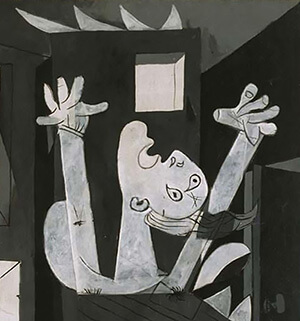 I find the buildings themselves to exist admittedly fascinating too—you might miss them at commencement glance, since they fade into the background behind the screaming figures simply the longer yous wait at Guernica, the more of the phase you'll meet.
In one spot, a peaked roof is turned on its side. There a building burns. And all around, empty doorways and windows gape like missing teeth and empty middle socket in the burned out skull of a metropolis.
While the figures and symbols are a commentary on war in general, and the setting of this painting perfectly represents the town of Guernica, blasted into rubble by the bombs of the Luftwaffe.
Symbols
Placed centrally in the painting, Picasso painted a rearing horse with rolling eyes and distended teeth—its face is so anguished, you can about hear it scream and you even might miss the spear piercing it from back to front. On the left, a bull seems to baby-sit the mother and kid, or perhaps looms over them like the shadow of the war, while in the afar background, barely visible, a bird shrieks at the sky.
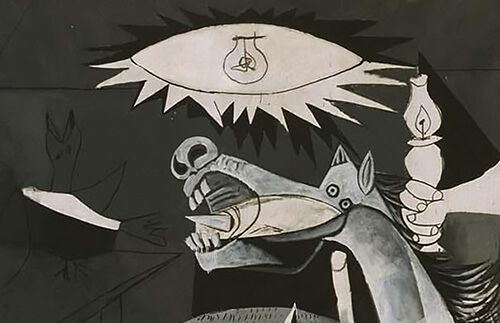 While the bull may indeed symbolize war (or perchance bullfighting, referencing both Spain in particular and the human desire for potency in full general) I believe the suffering horse is a metaphor for the undeserved death that state of war frequently brings to the innocent.
Even more than telling is the electric bulb casting a harsh lite from above, in sharp dissimilarity to the mitt-held oil lamp. Picasso placed those two elements right next to each other for a reason:
In a nutshell, he's showing the harsh reality of progress—for all the expert that it brings (electricity, automobiles. . . planes) it as well brings decease and devastation.
The human element
Like the dying horse, the expiry of the kid in its mother's arms symbolizes the suffering of the innocent. And everywhere else in this painting we but see the atrocities of war. Limbs are huge, swollen and wounded. Mouths gape in soundless screams, eyes are wide in terror, brows are furrowed in anguish.
A unmarried warrior lies broken and dismembered at the base of operations of the painting, trampled by the decease throes of the equus caballus above him. His arm clutches a broken sword, separated from his body. In Guernica nosotros find no solace in humanity—all is death and destruction.

Picasso painted Guernica over the course of merely 35 days, a stunning achievement for such a large work, particularly one that has fabricated such a marking in history.
Picasso'south painting techniques & materials
While Picasso is best-known for his modernistic, abstract paintings, he still learned to describe and pigment realistically at a very young age. His own fashion of painting only began to sally when he was 19 and living in Paris. It began with his "Blue Catamenia" (quickly followed past his "Rose Period") which were named because of the predominantly bluish and pink hues used throughout his paintings at that time.
As Picasso began to experiment more with Cubism, he switched to a limited range of oil paints in muted world tones. Today's version of Picasso'due south Cubist color palette would include colors like Burnt Umber and Burnt Sienna, Yellow Ochre, Titanium White, French Ultramarine Blue, and Ivory Black. The artist himself was said to employ the Sennelier brand of paints (which had a stiff texture prized by the Impressionists for its ability to make thick daubs on the canvas) and was readily available in Paris at the end of the 19th century.
Read adjacent — How to Add Incredibly Thick Texture to Your Acrylic Paintings
Picasso was also known for finding less "creative" paints (like those used in industrial applications) and calculation them to his palette also. Other non-art objects were pressed into service too: in Guernica, for instance, he added pieces of wallpaper for texture, and at other times he mixed sand into his paint, or bits of newspaper.
A typical Cubist painting by Picasso might showtime out with a Burnt Sienna groundwork and simple painted outline of his subject. By moving around his subject as he painted, Picasso was able to layer multiple angles and perspectives into a single prototype.
Picasso famously referenced his constantly-irresolute style of painting by proverb, "Information technology took me four years to pigment similar Raphael, simply a lifetime to pigment like a child."
How much is Guernica worth today?
Guernica has never been sold at auction, and so it's value is hard to decide—given its historical ties to Spain, and the earth-broad fame of Picasso, it'south unlikely that Guernica will ever exist sold.
That said, several other paintings by Picasso take sold in recent decades for well over 100 million dollars, so it's easy enough to hypothesize Guernica'southward value. Given the large size of Guernica (compared to Picasso's other paintings) likewise every bit its historical and cultural significance, its value would probably exceed 200 1000000 dollars if information technology went upward for sale.
Ownership controversy
Picasso intended for the painting to exist a gift to the people of Spain, but its ownership has at times been the subject of disagreement. The main reason for this is considering in 1937 the Spanish Republic gave Picasso 150,000 French francs to assist pay for some of his expenses in creating Guernica (roughly $7,500 or in today's dollars, $135,000).
It'southward unclear whether Picasso considered Guernica "sold" to the Spanish government, although sources close to the artist say he did Not consider it a sale. The Spanish regime on the other hand, says that they either acquired it, or commissioned information technology in 1937.
Whoever the owner was at the time, Picasso himself chose to display Guernica at the Earth's Fair in Paris in 1937, also as various exhibits around the world before entrusting it to the Museum of Modernistic Art from 1939 until 1981 (he asked that MoMA proceed the painting until Spain was a stable democracy). Accordingly, in 1981 Guernica returned to Kingdom of spain through an agreement with Picasso'southward heirs, MoMA, and the Spanish government.
Where is Guernica located?
If you're in Spain, you tin see Guernica in person at the Museo Reina Sofia in Madrid. Guernica takes upward an unabridged wall in room 206.06, on the 2nd floor of the Sabatini Edifice. Access to the museum costs 10 € and is open weekdays (except Tuesdays) from 10am to 9pm. The museum as well offers reduced hours on Sundays and holidays.
You can also get free admission to Museo Reina Sofia from vii-9pm on weekdays (except Tuesdays) and on Sundays from 1:30 to 7pm.
Source: https://emptyeasel.com/guernica-famous-cubist-painting-by-pablo-picasso/
0 Response to "What MediumsArt Materials Did Pablo Picasso Use What Materials Did Pablo Picasso Use"
Postar um comentário