When Franklin Roosevelt Got Polio Fdr as a Baby
 Spider web Content Display
Web Content Brandish
Introduction
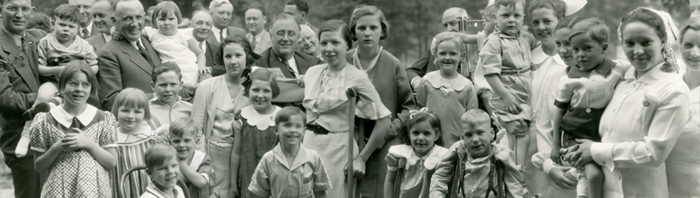
Franklin D. Roosevelt was the 32nd President of the United States. Not only did he serve an unprecedented 4 terms in office, just he was too the starting time president with a meaning physical disability. FDR was diagnosed with infantile paralysis, better known as polio, in 1921, at the age of 39. Although dealing with this crippling disease was difficult, many believe that his personal struggles helped shape FDR, both as a human and as a president.
Web Content Display
Polio Strikes
Coming from a wealthy family, FDR was privileged to savour his summers at the Campobello Island family unit cottage that was purchased past his parents in New Brunswick, Canada. It was at this site that FDR manifested the symptoms of "the insidious and mortiferous enemy" known as infantile paralysis. No 1 is certain of the circumstances leading to his wrinkle of polio, many believe he was exposed to the virus at a Boy Watch campsite in New York just prior to going to Campobello.
Web Content Display
Spider web Content Display
During the summer of 1921, FDR was enjoying a day of sailing on his yacht when he of a sudden barbarous overboard into the icy waters of the Bay of Fundy, which ironically felt paralyzing to his body. The following mean solar day, FDR complained of lower back hurting and went for a swim in hopes to ease the soreness. Equally the day progressed, he could feel his legs becoming weaker and by the third 24-hour interval, he could no longer hold his own weight. His skin apace became very sensitive and somewhen even a slight breeze beyond his body acquired great distress.
Eleanor, who couldn't bear to see her husband in such anguish, began to contact a scattering of doctors, hoping one of them would be able to detect a remedy to his unknown infirmity. One of these doctors was Dr. Bully who insisted the issue stemmed from a claret clot located in the lower spinal cord and recommended that he receive lumbar massages daily in order to help circulation. Days later, FDR was notified by Dr. Keen that his earlier diagnosis was wrong and instead he claimed the distress was existence acquired past spinal lesion. The massage therapy continued only did not bear witness to be successful in curing the paralysis.
On August 25, 1921, another physician, Dr. Robert Lovett, diagnosed FDR with infantile paralysis (i.e. polio). At that time, polio had no known cure and often resulted in full or fractional paralysis and the erosion of one's motor skills. Lovett, who was an good on the disease, insisted Franklin stop the massages, as they were not helping the situation and possibly making it worse; he instead suggested that he take hot baths.
Both FDR and Eleanor were surprised past this verdict, equally it was uncommon for a centre aged person to contract polio. Nearly cases of the disease were acquired during infancy, but nearly children become immune to the affliction by the age of four. Lovett explained that in lodge for a person to gainsay poliomyelitis, they must exist in good emotional and physical health and have a healthy allowed organisation. This made FDR rethink the actuality of having the disease since he could think frequently becoming ill as a young boy, just for the past few years he had been leading a stressful life in politics that may take weakened his immunity. At the young age of thirty-nine, FDR became a victim of infantile paralysis.
Recovery and Rehabilitation
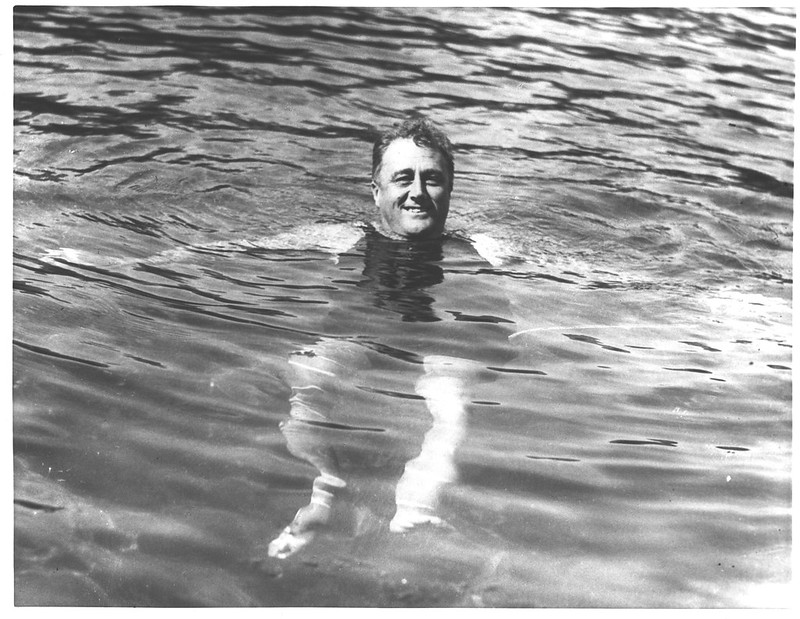
It was during fall of 1921, when FDR made the decision to remove himself from political life in lodge to brainstorm his rehabilitation procedure at his abode in Hyde Park, New York. For several years, his principal focus shifted from politics to recovering from his paralysis. FDR began routinely swimming 3 times a week in the Astor puddle and in the swimming. He had realized that his legs could support the weight of his torso in water with ease and used swimming every bit his main exercise. By the wintertime of that year, his artillery regained force, his nervous system was functioning ordinarily, and his stomach and lower back were getting stronger (Gallagher 23).
In January 1922, FDR was fit with braces that locked in at the knee and continued the length of his leg, and by the leap of that year he could stand up with assist. FDR made a plan that one day he would walk the length of his driveway, which was a quarter-mile long. Although he never accomplished the task, he used it equally a training process, working himself to the bone in hopes that he would be able to walk again if he connected exercising.
Due to his bright personality, FDR insisted that he be surrounded by "good cheer" throughout his rehab procedure. He was known for exercising constantly, even when he was surrounded by friends. He would oftentimes have people watch him and provide company as he exercised and would carry out a chat with them despite devoting all his attempt to moving.
FDR as well involved his children and family with his daily exercise rituals. At first, his children were heartbroken seeing their begetter in such a vulnerable state, struggling to move. Eventually they became comfortable around his condition and were proactive in helping him and involving themselves with his rehabilitation procedure. Eleanor recalled, "The perfect naturalness with which the children accepted his limitations though they had ever known him as an active person, helped him tremendously in his ain credence of them" (Roosevelt, Autobiography 142).
Spider web Content Display
 Prescription from Dr. Linder Inc. for leg braces. Includes a handwritten note from FDR saying the braces don't fit. July 5, 1926. From collection: FDR Family unit, Business, Personal Papers. File: "Infantile Paralysis"
Spider web Content Display
Warm Springs, Georgia
During his rehabilitation process, FDR was contacted by George Foster Peabody, a friend who knew of his recent polio attack. Peabody recently learned of an incident where a young man by the name of Louis Joseph, who was stricken by infantile paralysis, was cured past the "healing waters" of Warm Springs. After hearing of this story, he recommended the Warm Springs facility to FDR, hoping he too would become miraculously cured by its medicinal waters.
In 1924, FDR made a trip to the Georgia resort with high hopes that the mineral h2o in the springs could treat his paralysis. The spring's water came from Pine Mountain and was known to be rich in mineral content and extremely pure. Although the waters did non restore FDR to ultimate health, his continued visits throughout his political life resulted in an increase in the resort's popularity and business.
In 1926, Warm Springs was having financial issues. As its favorite visitor, FDR couldn't permit the facility to close down; instead, he bought the facility for $200,000 and transformed it into a rehabilitation center for polio patients similar himself. The following year, the Warm Springs Foundation was considered a permanent hydrotherapeutic eye by the American Orthopedic Association.
Above: Domicile moving-picture show footage of various scenes, circa 1928, showing areas effectually the treatment facility at Warm Springs, GA. Included in this silent footage are shots of FDR swimming, receiving therapy, and attending picnics.
Web Content Display
Render to Political Life
FDR made remarkable progress in Hyde Park and Warm Springs, and all his time was well spent during his rehabilitation period. His efforts and exercises conspicuously paid off, but he still remained a paraplegic. Roosevelt had such organized religion that ane day he would be able to walk again. His stubborn confidence resulted in a personal ultimatum: he either needed to accept the progress he had fabricated and return to politics or surrender his political dreams in hopes of breaking out of this brackish phase of recovery.
Eleanor likewise played a huge office in convincing FDR to resume his political career. As his wife and co-pilot, she knew he would non be happy in the stop if he had decided to terminate his activity in politics. FDR's close friend and political advisor, Louis Howe, also urged FDR to participate in politics again. Though this decision to return to the political world was supported past 2 people he respected, it was besides looked down upon past the person he cared about the near, his mother. She became very concerned with his health and suggested that he retire completely from his hectic life as a politician. Of course if it had non been for Eleanor and Howe, America might not have had the experience of having FDR in role, nor anything that stemmed from his presidency. (Gallagher 20)
As FDR made his mode back into political life, he was unsure how the public would react to his disability. Since his withdrawal from the public middle, non many people knew exactly what had happened to FDR. In that location were many rumors concerning his wellness and his physical state.
All of this made it even more difficult for FDR to stay emotionally strong and confident while making his way dorsum into the limelight. His first attempt to regain political interest was to support New York Country Governor Al Smith in the 1924 Autonomous Convention. This was FDR'south first public appearance since his polio attack and everyone was curious about his condition.
FDR had expected the public to care for him like any other paraplegic at the fourth dimension, with ignorance. During the 1920's, inability was frowned upon. Often disabled family members were put into asylums and banished from the family unit. The disabled were non employable and were often removed from club.
Equally FDR began to move upward on the political ladder, Americans were not shaken by his disability. More citizens were sympathetic to his condition rather than embarrassed. Fueled past America'southward "practiced cheer" and credence, FDR gained more confidence in his political career and ran for governor of New York in 1928. His disability did not affect his votes and as a result, he held the governorship for two terms until he decided to run for President in the 1932 election.
His political advisors oftentimes worried about how successful FDR would be in the election. They feared the words of his opponents and the names people ofttimes called him hoping to break his stride. Despite all of this, FDR's disability was never brought upward as a problem throughout his 1932 entrada and presidency and did not affect America's love for him.
Web Content Display
Living with Disability
In private, FDR used a special wheelchair he designed himself. He refused to employ a "regular" wheelchair because the chairs of the fourth dimension were 1-size-fits-all, bulky and a nuisance to become effectually in. Well-nigh buildings during his era were not wheelchair accessible; therefore Roosevelt needed something small, appealing, efficient, and discreet. To attain this, he used a dining chair and replaced the legs with wheel-like wheels. The chair was small and could move around tight corners and narrow hallways with ease. His wheelchair did not phone call a lot of attention since it was made out of something people were used to seeing in their ain homes.
Although FDR's inability did not directly interfere with his part as President, he was not completely comfortable being open nearly his situation.
Masking his disability in his home was ane matter, merely the real challenge arose when he was asked to announced in public or deliver a speech. Ofttimes he was required to navigate to a podium or area in which he would greet listeners. Of course FDR could take simply chosen to remain in his wheelchair during public events, but he wanted to assure America that he was capable. He never wanted Americans to get the impression that he was helpless, so information technology was important to him to at least seem equally if he could walk.
FDR devised a method of "walking" in which he used a cane and the arm of his son or counselor for remainder. He would maneuver his hips and swing is legs forward in a swaying move to go far appear as if he was walking. Stairs were also a challenge for FDR, he learned to back up his weight with just his artillery, holding himself upward as if he were on parallel bars, and swing his way down toward the adjacent stride.
FDR requested that the press avert photographing him walking, maneuvering, or beingness transferred from his car. The stipulation was accepted by nigh reporters and photographers but periodically someone would not comply. The Secret Service was assigned to purposely interfere with anyone who tried to snap a photo of FDR in a "disabled or weak" state (Gallagher 94).
Web Content Display
Legacy
Although FDR fabricated the choice to put his paralysis on the back burner in order to return to political life, he never gave up on the cause. Throughout his presidency, FDR made sure that he put endeavour into profitable those who suffered from polio.
Later ten years of setting upward Warm Springs so that it became the prime place for polio patients to receive therapy, FDR faced funding issues with the foundation. The first Birthday Brawl in 1934 was held in commemoration of FDR's birthday. He urged people in his honor to make budgetary donations to the facility and ended upwardly raising one million dollars for the Georgia Warm Springs Foundation.
The Birthday Balls continued in order to support both Warm Springs and FDR'due south National Foundation for Infantile Paralysis which he created four years subsequently in 1938. The fundraising for the National Foundation evolved into what nosotros at present know as the March of Dimes. This was a fund-raiser in which all of its proceeds went to the National Foundation for Infantile Paralysis. The almanac continuation of this occasion somewhen funded the research for the Salk vaccine to treat polio; unfortunately FDR never lived to see it.
FDR'due south disability was often called a "blessing in disguise" past his married woman. Eleanor had a way of looking at the big motion picture instead of worrying over the small stuff. She understood that the battles her husband fought in life were often more than what they seemed.
FDR's affliction threw him into a category frowned upon by almost of the American population. The fashion he viewed himself as a person, begetter and political leader despite his limitations helped others to alter the way they viewed others bedridden by disease or disability. Disabled or not, FDR became a symbol of strength and perseverance to Americans, showing them that "You gain force, courage and conviction past every experience in which you really end to wait fright in the face up. You are able to say to yourself, 'I have lived through this horror. I can take the next thing that comes along.'…You must practice the thing you think you cannot do" (Roosevelt, You Learn by Living 29-xxx).
Web Content Display
Primary Sources
- Franklin D. Roosevelt Family, Business and Personal Papers..
- Franklin D. Roosevelt President'southward Personal File..
Secondary Sources
- Gallagher, Hugh Gregory. FDR'southward Fantabulous Charade. Revised Edition ed. 1985. Arlington: Vandamere Printing, 1994...
- Roosevelt, Anna Eleanor. The Autobiography of Eleanor Roosevelt. Beginning Edition ed. New York: Harper & Brothers Publishers, 1937...
- Roosevelt, Eleanor. You Learn By Living. New York: Harper & Brothers Publishers, 1960...
Source: https://www.fdrlibrary.org/polio
0 Response to "When Franklin Roosevelt Got Polio Fdr as a Baby"
Postar um comentário